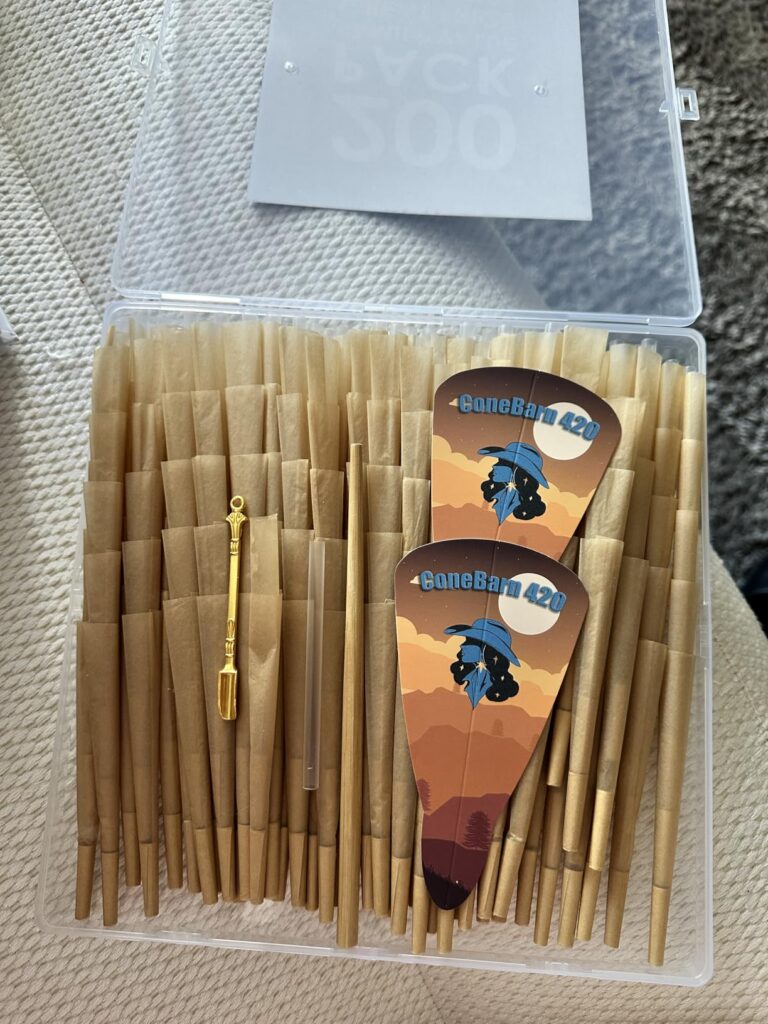
Quick answer: Pre-rolled cones remove the shaping step: they arrive empty but already formed into a cone. Rolling papers arrive flat and leave the shape to you. Choose cones when you want a repeatable starting format and a clear unit count. Choose rolling papers when you want to control each shape yourself and do not mind doing the rolling. Neither format proves better burn, taste, or paper quality on its own.
If you already know that you prefer a pre-shaped format, compare the current 200-count pre-rolled cone options before choosing a pack.
The difference in one table
| Decision | Pre-rolled cones | Rolling papers |
|---|---|---|
| Starting form | Empty paper already formed into a cone | Flat sheet or roll of paper |
| Work still required | Fill, settle the contents, and close the open end | Shape, roll, seal, and finish the roll |
| Shape control | The taper and starting dimensions are mostly set | The user controls the width, taper, and final shape |
| Quantity comparison | Count the individual cones in the pack | Count sheets or compare the length of a paper roll |
| Storage priority | Protect the hollow shape from crushing | Keep the booklet or roll dry and protected from bending |
| Best fit | Buyers who want fewer shaping steps | Buyers who value manual control over each roll |
The useful question is not which format wins in every situation. It is which steps you want the manufacturer to complete before the paper reaches you.
What “pre-rolled cone” actually means
A pre-rolled cone is pre-shaped, not pre-filled. The paper body and tip are already formed into a tapered shape, but the cone still arrives empty.
That removes one part of the process: turning a flat paper into a stable shape. It does not remove every step. You still need to fill the cone, settle the contents without damaging the paper, and close the open end.
This distinction matters because “pre-rolled” is sometimes used loosely. On a ConeBarn product page, check that the listing says the cones are empty and then verify the exact length, count, and included items.
What rolling papers keep under your control
Rolling papers leave more of the final format in your hands. You decide how wide the roll will be, how much taper it has, how tightly it is shaped, and whether a separate tip is part of your setup.
That flexibility is the main reason to choose papers. It is also the work that pre-rolled cones remove. Someone who already enjoys rolling by hand may not see that work as a disadvantage. Someone who repeatedly struggles to form the paper may value a pre-shaped starting point.
The skill difference should not be turned into a quality claim. A carefully made hand roll can suit its user better than a fixed cone, while a pre-rolled cone can make the starting shape more predictable. The better format depends on the buyer, not on a universal ranking.
Convenience means fewer shaping steps, not “better”
The strongest honest case for cones is procedural: the taper is already there. That can reduce the time and attention spent forming the paper before filling it.
It does not automatically mean:
- the paper will burn slower or more evenly;
- the material will taste different;
- the cone will hold a fixed weight;
- every user will find filling easier;
- the finished result will be identical every time.
Those outcomes can also depend on paper composition, dimensions, storage, filling density, handling, and other product-specific variables. Format alone does not prove them.
Shape control is the main tradeoff
With rolling papers, you can change the shape from one roll to the next. With a pre-rolled cone, you choose the format before buying and work inside that shape.
Choose rolling papers when:
- changing the width or taper is part of your routine;
- you prefer to shape every roll yourself;
- you already have a paper and tip setup that works;
- carrying a flat booklet is more practical than protecting empty cones.
Choose pre-rolled cones when:
- forming the paper is the step you most want to remove;
- you prefer buying a known number of individual empty cones;
- a consistent starting taper matters more than custom shaping;
- you have a rigid case or supported storage space for the pack.
Compare exact dimensions, not size names alone
Terms such as king size, slim, and 1 1/4 can help you navigate a category, but the printed name should not replace the dimensions. Check the actual length in millimeters and compare it with a format you already know.
For example, ConeBarn’s current flagship route identifies a 108mm empty cone. That number describes length; it does not state a universal fill weight, burn time, or capacity. Use the 108mm king-size cone guide when the physical format is still your main question.
Rolling papers need the same discipline. Compare the sheet length and width, not only the format name printed on the booklet.
Which format costs less?
There is no useful universal answer. A fair cost comparison needs the complete purchase, not one headline price.
- Check the exact number of cones or paper sheets.
- Check whether tips, packing tools, or a protective case are included.
- Compare the delivered total after shipping and discounts.
- Confirm that the dimensions match the format you actually want.
- Consider whether part of a large pack is likely to remain unused or get damaged.
Rolling papers may have a lower starting price in one store while a larger cone pack may have a lower cost per individual unit in another. The result changes with brand, count, included items, and shipping.
If count is the open question, use the ConeBarn quantity guide instead of assuming the largest pack is automatically the best value.
Storage is different for each format
Flat papers are compact, but their booklet still needs protection from moisture, creases, and repeated pressure. Empty cones need additional protection because their hollow bodies can be flattened or crushed.
For pre-rolled cones:
- keep the reserve supply in the packaging that supports its shape;
- use a rigid outer case for transport;
- avoid placing heavier objects on top of the pack;
- store the paper in a stable, cool, dry location away from direct sunlight.
For rolling papers:
- keep the booklet or roll closed when not in use;
- protect the edges from bending;
- keep separate tips organized if your setup uses them;
- avoid damp or high-heat storage locations.
A large cone pack is only useful when the remaining quantity can be stored without becoming damaged inventory.
A simple decision rule
Choose pre-rolled cones when your main problem is shaping the paper and you are comfortable choosing a fixed format before purchase.
Choose rolling papers when shaping is part of the experience you want and the ability to change each roll matters more than removing steps.
Keep both when the situation changes. Some buyers prefer papers when they have time and control, then use cones when a repeatable starting format is more useful. The two formats do not need to be treated as opposing teams.
Questions about cones and rolling papers
Are pre-rolled cones already filled?
No. The products discussed here are empty paper cones. Pre-rolled describes the formed shape, not filled contents.
Are pre-rolled cones easier than rolling papers?
They remove the paper-shaping step, which can make the setup simpler for someone who finds rolling difficult. They still need to be filled and handled without crushing the paper, so “easier” depends on which step causes the problem.
Do pre-rolled cones burn slower or more evenly?
The shape alone does not prove either result. Paper specifications, storage, filling density, and handling can all matter. Compare verified product facts instead of treating the format as a performance guarantee.
Are cones more expensive than rolling papers?
Not in every case. Compare exact count, dimensions, included items, shipping, and the quantity you will actually use. A per-unit figure without the delivered total can be misleading.
Do cones and rolling papers use the same material?
Do not assume that they do. Materials and formulations can differ between products. Check the manufacturer or seller documentation for the exact item.
Start with the step you want to remove
If you want control over every shape, rolling papers are the more direct tool. If you want the paper to arrive in a fixed tapered form, pre-rolled cones remove that shaping step.
Once that decision is clear, compare the current 200-count pre-rolled cones by exact size, pack contents, storage, and delivered cost.